
Reading and writing classes
Stronger Readers. Sharper Writers. Lifelong Thinkers.
Enrichment classes for students who are ready to level up.
Committed to academic quality, student learning, and continuous improvement.

The Problem
Is your child coasting in reading and writing?
Many students read fluently but don’t deeply understand what they read. Others have ideas but struggle to organize their writing. And in busy classrooms, they rarely get the personalized feedback they need to grow.
Without structure and challenge, strong students stall. And struggling ones fall further behind.

The Solution
Our reading and writing classes provide students with the skills and structure they need to grow.
Our year-long reading & writing classes are designed for students who are ready for more. We build critical readers and confident writers through structured instruction, small-group teaching, and research-backed strategies rooted in the Science of Reading.
Integrated Reading and Writing Classes

The Masterpiece Academy is Northern Virginia’s Reading & Writing Specialist — delivering teacher‑led, Common Core and College Ready, VA 2024 SOL–aligned literacy instruction for homeschool families (K–12) and enrichment‑focused writing classes for public school students (K–8).
Unlike worksheet‑based programs, we teach students how to read deeply, think critically, and write clearly across genres, using a full writing‑process model: prewriting, drafting, response, revision, editing, and publication.
90 Minutes of Engaging, Interactive Reading and Writing Instruction
Every Integrated Reading and Writing class follows a purposeful instructional routine designed to strengthen reading comprehension, critical thinking, and written communication.
Our live, teacher-led sessions combine explicit instruction, meaningful discussion, guided practice, and independent writing. Students actively engage with grade-appropriate texts and apply what they learn to their own writing.
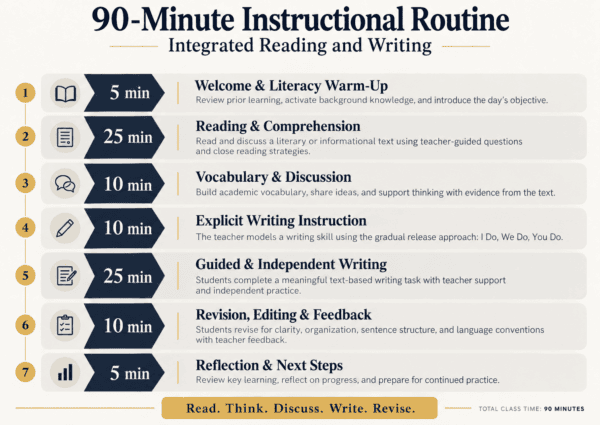
Our 90-Minute Class Routine
1. Welcome & Literacy Warm-Up | 5 Minutes
Students begin with a brief review and engaging activity that activates prior knowledge, reinforces previously learned skills, and introduces the day's learning objectives.
2. Reading & Comprehension | 25 Minutes
Students engage in close reading of carefully selected literary or informational texts. Through teacher-guided reading and text-dependent questions, students practice identifying central ideas, interpreting details, making inferences, and understanding the author's message.
3. Vocabulary & Collaborative Discussion | 10 Minutes
Students explore vocabulary and academic language from the reading selection. Through purposeful discussion, they share interpretations, explain their reasoning, and support their thinking with evidence from the text.
4. Explicit Writing Instruction | 10 Minutes
The teacher models a targeted writing skill connected to the reading. Students learn how effective writers construct sentences, organize ideas, develop paragraphs, incorporate textual evidence, and communicate clearly.
Instruction follows a gradual release approach:
-
I Do: The teacher demonstrates and explains.
-
We Do: Students practice with guidance from the teacher.
-
You Do: Students apply the skill independently.
5. Guided & Independent Writing | 25 Minutes
Students apply their reading comprehension and writing skills to a meaningful, text-based writing task.
Depending on grade level and lesson objectives, students may write responses, develop paragraphs, analyze texts, or compose extended pieces.
The teacher guides and supports students as they develop their ideas, organize their writing, and practice increasingly independent written expression.
6. Revision, Editing & Teacher Feedback | 10 Minutes
Students review their writing for clarity, organization, supporting evidence, sentence structure, and appropriate language conventions.
Through teacher feedback and guided revision, students learn how to strengthen their written responses and make purposeful improvements.
7. Reflection & Next Steps | 5 Minutes
The session concludes with a brief review of key learning objectives, student reflection, and guidance for continued practice.
Our Instructional Philosophy
Read. Think. Discuss. Write. Revise.
Students develop stronger literacy skills when meaningful instruction and consistent practice connect reading and writing.
Each 90-minute session provides opportunities for active participation, thoughtful discussion, and purposeful writing—not passive learning.
Program at a Glance
-
Instruction: Live, teacher-led online classes
-
Session Length: 90 minutes
-
Program Duration: 7 consecutive weeks
-
Grade Levels: 3–5, 6–8, and 9–12
How the routine changes by grade level
Although the class structure stays consistent, the academic expectations become progressively more challenging.
|
Grades |
Primary instructional emphasis |
|---|---|
|
3–5 |
Reading comprehension, vocabulary, sentence development, paragraph writing, and text-based responses |
|
6–8 |
Close reading, critical analysis, citing evidence, paragraph organization, and multi-paragraph writing |
|
9–12 |
Complex texts, literary and rhetorical analysis, thesis development, argumentation, and academic writing |
Build Stronger Readers. Develop Confident Writers. Enroll Today!
Read with Understanding. Write with Clarity. Communicate with Confidence.
7-Week Live Online Program | Teacher-Led Instruction | $775
Build Stronger Readers and More Confident Writers
Is your child struggling to understand what they read, organize their thoughts in writing, or support their answers with evidence from a text?
Strong reading and writing skills are essential for academic success. As students progress through elementary school, they are expected to read increasingly complex texts, think critically, expand their vocabulary, and communicate their understanding through organized written responses.
Our Integrated Reading and Writing program for Grades 3–5 strengthens these essential literacy skills through structured, engaging, teacher-led online instruction.
Grounded in the national ELA standards, including Virginia's 2024 English Standards of Learning (SOL), the program brings reading comprehension, vocabulary development, critical thinking, and purposeful writing together in meaningful learning experiences.
Students don't just practice reading and writing separately. They learn to use what they read to develop ideas, explain their thinking, and communicate more effectively.
What Will Your Child Learn?
Reading Comprehension & Critical Thinking
Students develop strategies to understand, interpret, and analyze literary and informational texts.
They practice identifying central ideas, themes, supporting details, author's purpose, making inferences, and drawing conclusions.
Vocabulary & Word Knowledge
Students strengthen vocabulary through context clues, word relationships, prefixes, suffixes, and root words.
These skills support reading comprehension, word recognition, and more precise written communication.
Sentence & Paragraph Development
Students learn to construct complete sentences, expand ideas using relevant details, and organize their thinking into clear, coherent paragraphs.
Instruction emphasizes sentence structure, grammar, organization, and meaningful written expression.
Evidence-Based Reading & Writing
Students practice answering text-dependent questions, selecting relevant supporting details, and using textual evidence to explain their understanding.
They learn to connect reading comprehension with organized written responses.
Writing for Different Purposes
Students develop grade-appropriate narrative, informational, explanatory, and opinion writing skills.
They learn to plan, draft, organize, revise, and edit their writing with increasing independence.
Test-Taking Skills & Strategies
The program integrates test-taking strategies throughout the seven-week program.
Students practice understanding questions, identifying important information, eliminating unsupported answer choices, locating textual evidence, and reviewing responses for accuracy.
These strategies help students approach classroom assessments and Virginia SOL-style reading questions with greater confidence and independence.
Personalized Learning Begins with Assessment
Literacy Diagnostic Assessments Included in Tuition
Every student begins with a pre-class literacy diagnostic assessment designed to identify individual strengths and learning needs.
Assessments and ongoing skill observations focus on:
- Decoding & Word Recognition: Evaluating word-reading skills and foundational decoding abilities, as appropriate to student needs.
- Reading Behaviors: Observing reading accuracy, fluency, self-monitoring, and reading strategies during instruction.
- Reading Comprehension: Evaluating understanding of literary and informational texts, inferences, and evidence-based responses.
- Guided Writing Assessment: Examining sentence structure, paragraph organization, written expression, grammar, and writing conventions.
Before Classes Begin
Students complete an initial diagnostic assessment through our Learning Management System. The results help the teacher identify instructional priorities and set targeted learning goals.
Throughout the Program
Students receive ongoing opportunities to demonstrate comprehension, practice writing, and improve their work through teacher guidance and feedback.
All literacy assessments are included in tuition. There are no additional assessment fees.
Explore Our 7-Week Learning Journey
Week 1: Reading Comprehension & Strategic Reading
Develop essential strategies for understanding literary and informational texts, identifying key ideas, and making inferences.
Week 2: Vocabulary Development & Word Analysis
Expand vocabulary knowledge through context clues, word relationships, and meaningful word parts while strengthening sentence construction.
Week 3: Literary Analysis & Textual Evidence
Explore characters, plot, theme, and the author's message while supporting written responses with evidence.
Week 4: Informational Reading & Paragraph Development
Understand informational texts and organize ideas into clear, well-developed paragraphs.
Week 5: Integrated Reading & Writing Applications
Connect reading comprehension with purposeful writing through sentence development, narrative writing, and explanatory compositions.
Week 6: Critical Thinking, Written Reasoning & Revision
Strengthen reasoning, express opinions with supporting evidence, and improve writing through revision and editing.
Week 7: Integrated Literacy & Test-Taking Application
Apply reading comprehension, vocabulary, written expression, and test-taking strategies through culminating literacy activities.
We reinforce test-taking strategies throughout all seven weeks, not just in the final session.
Why Choose Our Integrated Reading and Writing Program?
Standards-Informed Instruction
Our curriculum focuses on important reading, writing, vocabulary, and language skills emphasized in Virginia's 2024 English Standards of Learning.
Assessment-Guided Learning
Pre-class diagnostic assessment results help identify students' strengths and instructional needs.
Live, Teacher-Led Classes
Students participate in structured lessons with opportunities for guided practice, discussion, and feedback.
Reading and Writing Together
Students learn to apply comprehension, vocabulary, and critical thinking directly to written communication.
Purposeful Writing Practice
Students regularly engage in text-based writing activities designed to develop organization, clarity, and written expression.
Integrated Test-Taking Strategies
Students develop strategic reading and reasoning skills within regular instruction, reinforcing skills useful for classroom and standardized assessments.
Program Details & Tuition
Integrated Reading and Writing — Grades 3–5
- Program Duration: 7 Consecutive Weeks
- Class Length: 90 Minutes per Session
- Class Frequency: Once per Week
- Total Live Instruction: 10.5 Hours
- Format: Live, Teacher-Led Online Classes
- Tuition: $775 per Student
- Pre-Class Diagnostic Assessments: Included
- Ongoing Reading & Writing Assessments: Included
Your $775 Tuition Includes
- Seven 90-minute live online instructional sessions
- Pre-class literacy diagnostic assessments
- Assessment-guided instructional planning
- Reading comprehension and vocabulary instruction
- Guided and independent writing activities
- Ongoing teacher feedback and skill monitoring
- Integrated test-taking skills and strategies
- Culminating reading and writing application
- Access to instructional materials through our Learning Management System
One Complete Literacy Enrichment Program. No Additional Assessment Fees.
Give Your Child the Tools to Succeed
Reading and writing are foundational skills that influence learning across every academic subject.
Help your child develop the confidence to understand increasingly challenging texts, express ideas clearly, support responses with evidence, and become a stronger, more independent learner.
Invest in Stronger Reading and Writing Skills.
Read Critically. Think Deeply. Write with Purpose.
7-Week Live Online Program | Teacher-Led Instruction | $775
Cognia Accredited with Honors Recognition
Strengthen Reading Comprehension. Develop Critical Thinking. Build Confident Writers.
Middle school marks an important transition in a student's academic journey. As reading materials become more complex and writing expectations increase, students must learn to analyze information, evaluate evidence, build arguments, and communicate their ideas effectively.
Our Integrated Reading and Writing program for Grades 6–8 provides rigorous, structured literacy instruction designed to help students become stronger readers, analytical thinkers, and confident academic writers.
Through live, teacher-led online instruction, students develop essential reading comprehension, academic vocabulary, critical thinking, and written communication skills.
Instead of teaching reading and writing as separate subjects, our integrated approach helps students see how reading, discussion, analysis, and purposeful writing work together to support academic success.
Academic Excellence & Standards Alignment
Nationally Recognized Standards. Rigorous Academic Expectations.
Our Integrated Reading and Writing curriculum is designed around rigorous English Language Arts and literacy expectations reflected in leading educational frameworks across the United States.
Our curriculum incorporates the following standards frameworks:
- Common Core State Standards (CCSS) — English Language Arts and Literacy
- Texas Essential Knowledge and Skills (TEKS) — English Language Arts and Reading
- Florida's Benchmarks for Excellent Student Thinking (B.E.S.T.) Standards — English Language Arts
- Department of Defense Education Activity (DoDEA) — College and Career Ready Standards for English Language Arts and Literacy
- Virginia's Updated 2024 English Standards of Learning (SOL)
These frameworks emphasize essential academic competencies, including comprehension of complex texts, vocabulary development, literary and informational analysis, evidence-based reasoning, writing proficiency, communication, and research.
Instruction is differentiated to address the increasing academic expectations of Grades 6, 7, and 8.
Cognia Accreditation with Honors Recognition
Our educational organization holds Cognia accreditation with honors recognition, reflecting a commitment to educational quality, institutional effectiveness, and continuous improvement.
Students benefit from a structured learning environment that emphasizes rigorous academic expectations, assessment-guided instruction, and meaningful skill development.
What Will Your Child Learn?
Critical Reading & Text Analysis
Students develop strategies to interpret and analyze complex literary and informational texts.
Instruction emphasizes identifying central ideas, themes, author's purpose, text structures, making inferences, evaluating supporting details, and drawing evidence-based conclusions.
Academic Vocabulary & Language Development
Students strengthen academic vocabulary through word analysis, context clues, word relationships, figurative language, and meaningful word parts.
Vocabulary instruction is integrated into reading and writing activities to support comprehension and precise written communication.
Literary Analysis & Textual Evidence
Students examine characterization, conflict, theme, point of view, and author's craft.
They learn to explain interpretations clearly and support their thinking with relevant textual evidence.
Paragraph Development & Academic Composition
Students develop organized paragraphs and coherent multi-paragraph compositions.
Instruction emphasizes controlling ideas, thesis development, topic sentences, supporting evidence, logical transitions, and effective conclusions.
Analytical, Explanatory & Argumentative Writing
Students practice writing for different purposes and audiences.
They learn to develop clear claims, explain information, evaluate evidence, construct reasoned arguments, and organize ideas effectively.
Critical Thinking & Evidence-Based Reasoning
Students learn to evaluate information, compare perspectives, distinguish supported conclusions from assumptions, and explain their reasoning.
These skills strengthen academic performance across subjects.
Revision, Editing & Written Communication
Students practice improving sentence structure, organization, vocabulary, clarity, grammar, punctuation, and writing conventions through guided revision and teacher feedback.
Personalized Learning Begins with Assessment
Comprehensive Literacy Assessments Included in Tuition
Every student begins with a pre-class diagnostic assessment designed to identify current reading and writing strengths, learning needs, and instructional priorities.
Assessment components include:
Reading Comprehension Assessment
Evaluates students' ability to understand, interpret, summarize, and analyze grade-appropriate literary and informational texts.
Vocabulary & Word Analysis Assessment
Examines students' understanding of academic vocabulary, word meanings, context clues, and word relationships.
Reading Behaviors & Fluency Assessment
Uses teacher observation and appropriate reading activities to evaluate reading accuracy, fluency, self-monitoring, and comprehension strategies.
Critical Thinking & Textual Evidence Assessment
Evaluates students' ability to make inferences, analyze ideas, interpret evidence, and explain their reasoning.
Guided Writing Assessment
Examines students' ability to construct clear sentences, develop organized paragraphs, support ideas with evidence, and apply appropriate grammar and writing conventions.
Foundational Reading Skills Screening
When student needs indicate it, additional decoding and word-recognition screening helps identify foundational skills that need reinforcement.
Before Classes Begin
Students complete an initial diagnostic assessment through our Learning Management System (LMS). Assessment results help the teacher identify individual strengths and instructional priorities.
Throughout the Program
Teachers monitor reading comprehension, vocabulary development, reading behaviors, analytical reasoning, and writing progress through meaningful instructional activities and feedback.
All diagnostic and ongoing instructional assessments are included in the $775 tuition. No additional assessment fees are required.
Explore Our 7-Week Learning Journey
Week 1: Critical Reading & Strategic Comprehension
Students develop close-reading and comprehension strategies to interpret literary and informational texts.
Skills: Central ideas, inference, objective summaries, text structure, evidence, and written responses.
Week 2: Literary Analysis & Textual Evidence
Students analyze themes, characters, conflicts, point of view, and author's craft, supporting their interpretations with evidence.
Skills: Literary interpretation, textual evidence, analytical paragraphs, and written reasoning.
Week 3: Informational Reading & Critical Analysis
Students evaluate informational texts, identify claims and supporting details, analyze the author's purpose, and examine how ideas are developed.
Skills: Informational comprehension, argument analysis, vocabulary, and critical thinking.
Week 4: Academic Writing & Paragraph Organization
Students strengthen paragraph development and academic composition through explicit writing instruction.
Skills: Thesis development, controlling ideas, topic sentences, evidence integration, transitions, and writing organization.
Week 5: Comparative Reading & Evidence-Based Writing
Students compare related texts, evaluate differing perspectives, and develop organized explanatory and analytical writing.
Skills: Compare texts, synthesize information, explain evidence, and write multi-paragraph responses.
Week 6: Argumentative Writing, Reasoning & Revision
Students construct reasoned arguments, support claims with evidence, and improve their written work through revision.
Skills: Argument development, supporting reasons, counterarguments when appropriate, grammar, editing, and writing clarity.
Week 7: Integrated Reading, Writing & Test-Taking Application
Students apply the skills developed throughout the program to culminating reading and writing activities.
Instruction includes focused practice in strategic reading, question analysis, evidence evaluation, time management, and response accuracy.
Skills: Independent comprehension, analytical reasoning, academic writing, revision, and assessment strategies.
We embed test-taking skills and strategies throughout all seven instructional weeks.
How Our Classes Work
90 Minutes of Engaging, Interactive Reading and Writing Instruction
Each live session follows a purposeful instructional routine that connects reading, discussion, critical thinking, and writing.
- Welcome & Literacy Warm-Up — 5 Minutes
Review previous learning, activate background knowledge, and introduce the day's objectives.
- Reading & Comprehension — 25 Minutes
Engage in close reading and guided analysis of literary and informational texts.
- Vocabulary & Discussion — 10 Minutes
Explore academic vocabulary, discuss interpretations, and support ideas with textual evidence.
- Explicit Writing Instruction — 10 Minutes
Learn targeted writing skills through teacher modeling, guided practice, and instructional examples.
- Guided & Independent Writing — 25 Minutes
Apply reading comprehension and analytical skills to meaningful written responses and compositions.
- Revision, Editing & Teacher Feedback — 10 Minutes
Strengthen writing through revision, editing, and teacher guidance.
- Reflection & Next Steps — 5 Minutes
Review learning objectives, reflect on progress, and reinforce essential skills.
Test-Taking Skills & Strategies Integrated Throughout
Our curriculum incorporates test-taking strategies within regular reading and writing instruction rather than limiting them to isolated test-preparation lessons.
Students learn to:
- Analyze questions and identify important information.
- Apply strategic close reading and comprehension techniques.
- Distinguish explicit information from implied meaning.
- Evaluate evidence and eliminate unsupported answer choices.
- Understand multiple-choice and text-dependent questions.
- Interpret writing prompts and organize responses.
- Apply effective time-management strategies.
- Review answers for accuracy, completeness, and clarity.
Week 7 focuses on applying and reinforcing these skills through grade-appropriate practice activities.
Why Choose Our Integrated Reading and Writing Program?
Cognia Accreditation with Honors Recognition
Our educational organization emphasizes educational quality, rigorous expectations, and continuous improvement.
Multi-State and National Standards Alignment
Our curriculum incorporates literacy expectations from Common Core, Texas TEKS, Florida B.E.S.T., DoDEA College and Career Ready Standards, and Virginia's updated 2024 English SOL.
Assessment-Guided Instruction
Pre-class diagnostic results help identify student learning needs and inform instructional planning.
Live, Teacher-Led Learning
Students participate in interactive instruction with opportunities for discussion, guided practice, and feedback.
Reading and Writing as Connected Skills
Students apply comprehension, vocabulary, analysis, and critical thinking directly to written communication.
Purposeful Writing & Teacher Feedback
Students regularly practice developing, organizing, supporting, revising, and editing written responses.
Integrated Test-Taking Strategies
Students develop effective approaches to reading questions, evaluating evidence, and communicating accurate responses throughout the program.
Program Details & Tuition
Integrated Reading and Writing — Grades 6–8
- Duration: 7 Consecutive Weeks
- Class Length: 90 Minutes
- Class Frequency: Once per Week
- Total Live Instruction: 10.5 Hours
- Delivery: Live, Teacher-Led Online
- Tuition: $775 per Student
- Pre-Class Literacy Diagnostic Assessment: Included
- Ongoing Reading & Writing Assessments: Included
- Academic Framework: National and Multi-State Literacy Standards, Including Virginia's 2024 English SOL
- Availability: Northern Virginia, Nationwide, and Eligible International Online Learners
Your Tuition Includes
- Seven 90-minute live online instructional sessions
- Pre-class diagnostic literacy assessment
- Assessment-guided instructional planning
- Reading comprehension and vocabulary development
- Literary and informational text analysis
- Explicit academic writing instruction
- Guided and independent writing practice
- Ongoing teacher feedback and skill monitoring
- Integrated test-taking strategies
- Culminating reading and writing application
- Access to instructional materials through our Learning Management System
One Complete Middle School Literacy Enrichment Program. No Additional Assessment Fees.
Prepare Your Child for Greater Academic Success
Strong reading comprehension, critical thinking, and academic writing skills are essential as students transition from middle school to increasingly demanding high school coursework.
Our Integrated Reading and Writing program gives students structured opportunities to strengthen these skills through rigorous, standards-informed instruction.
Help your child become a stronger reader, a more thoughtful thinker, and a confident academic writer.
Read Critically. Think Deeply. Write with Purpose.
Analyze with Insight. Write with Precision. Communicate with Confidence.
7-Week Live Online Program | Teacher-Led Instruction | $775
Cognia Accredited with Honors Recognition
Build Advanced Reading Skills. Strengthen Academic Writing. Prepare for Greater Academic Success.
High school students face increasingly demanding academic expectations. Success requires more than understanding what they read. Students must analyze complex texts, evaluate arguments, synthesize information, develop defensible claims, and communicate their thinking through organized, evidence-based writing.
Our Integrated Reading and Writing program for Grades 9–12 provides rigorous, structured literacy instruction designed to strengthen advanced reading comprehension, critical thinking, analytical reasoning, and academic writing.
Through live, teacher-led online instruction, students develop the skills necessary to interpret challenging literary and informational texts, evaluate evidence, construct arguments, and express complex ideas with clarity and precision.
Rather than teaching reading and writing as separate subjects, our integrated instructional approach connects close reading, analytical discussion, critical thinking, and purposeful writing.
The program supports the development of transferable literacy skills needed for challenging high school coursework, college-level expectations, and future academic endeavors.
Academic Excellence & Standards Alignment
Nationally Recognized Standards. Rigorous Academic Expectations.
Our Integrated Reading and Writing curriculum incorporates rigorous English Language Arts and literacy expectations from recognized educational frameworks across the United States.
Our curriculum draws on:
- Common Core State Standards (CCSS) — English Language Arts and Literacy
- Texas Essential Knowledge and Skills (TEKS) — English Language Arts and Reading
- Florida's Benchmarks for Excellent Student Thinking (B.E.S.T.) Standards — English Language Arts
- Department of Defense Education Activity (DoDEA) — College and Career Ready Standards for English Language Arts and Literacy
- Virginia's Updated 2024 English Standards of Learning (SOL)
These academic frameworks emphasize essential competencies, including complex text comprehension, academic vocabulary, literary and rhetorical analysis, evidence-based reasoning, argument development, research, written communication, and critical thinking.
Instruction is differentiated to reflect the academic expectations of Grades 9–10 and Grades 11–12.
Cognia Accreditation with Honors Recognition
Our educational organization holds Cognia accreditation with honors recognition, reflecting our commitment to educational quality, rigorous academic expectations, and continuous improvement.
Our approach combines standards-informed instruction, assessment-guided learning, explicit teaching, and meaningful academic practice to support student growth.
What Will Your Child Learn?
Advanced Reading Comprehension & Critical Analysis
Students develop strategies to interpret, evaluate, and analyze increasingly complex literary and informational texts.
Instruction emphasizes identifying central ideas, examining themes, analyzing text structures, drawing inferences, evaluating supporting details, and developing evidence-based interpretations.
Academic Vocabulary & Language Development
Students expand academic vocabulary through context, word analysis, figurative language, word relationships, and precise language use.
Vocabulary instruction is integrated into reading and writing to support deeper comprehension and effective academic communication.
Literary Analysis & Author's Craft
Students examine how authors develop themes, characters, conflicts, perspectives, and meaning through literary techniques and structural choices.
They practice evaluating imagery, symbolism, figurative language, tone, and narrative techniques while supporting their interpretations with relevant textual evidence.
Rhetorical Analysis & Critical Thinking
Students analyze how authors use language, reasoning, evidence, and rhetorical strategies to communicate ideas and influence audiences.
They learn to evaluate arguments, recognize perspectives, distinguish credible evidence from unsupported claims, and explain how rhetorical choices contribute to meaning.
Thesis Development & Academic Composition
Students strengthen their ability to develop defensible thesis statements, organize complex ideas, and construct coherent analytical and argumentative compositions.
Instruction emphasizes logical organization, effective introductions, topic sentences, supporting evidence, meaningful commentary, transitions, and conclusions.
Analytical, Explanatory & Argumentative Writing
Students practice developing organized academic compositions for different purposes and audiences.
They learn to formulate claims, evaluate evidence, develop logical reasoning, address alternative perspectives, and communicate well-supported arguments.
Comparative Reading, Synthesis & Research
Students examine related texts, compare perspectives, evaluate information from multiple sources, and synthesize ideas into coherent written responses.
Instruction emphasizes responsible use of sources, evidence integration, and research-based reasoning.
Revision, Editing & Academic Writing Style
Students strengthen their writing through purposeful revision and editing.
Instruction focuses on clarity, coherence, sentence variety, precise word choice, academic tone, grammar, punctuation, and appropriate writing conventions.
Personalized Learning Begins with Assessment
Comprehensive Literacy Assessments Included in Tuition
Every student begins with a pre-class diagnostic assessment designed to identify current reading and writing strengths, learning needs, and instructional priorities.
Assessment components and ongoing observations focus on:
Advanced Reading Comprehension
Evaluating students' ability to understand, interpret, summarize, and analyze complex literary and informational texts.
Academic Vocabulary & Word Analysis
Examining students' knowledge of academic vocabulary, word meanings, figurative language, contextual relationships, and precise language use.
Literary & Rhetorical Analysis
Assessing students' ability to interpret literary techniques, analyze the author's craft, identify rhetorical strategies, and explain how language and structure contribute to meaning.
Critical Thinking & Evidence-Based Reasoning
Evaluating students' ability to make inferences, interpret arguments, assess supporting evidence, and explain their reasoning.
Academic Writing Assessment
Examining students' ability to develop thesis statements, organize analytical responses, integrate textual evidence, construct coherent paragraphs, and apply appropriate academic writing conventions.
Reading Behaviors & Foundational Skills, When Needed
Teacher observations may identify difficulties with reading fluency, self-monitoring, or foundational word-reading skills. Additional screening may be used when appropriate to individual learning needs.
Before Classes Begin
Students complete an initial diagnostic reading and writing assessment through our Learning Management System (LMS).
Assessment results help the teacher identify individual strengths, learning needs, and instructional priorities.
Throughout the Program
Teachers monitor comprehension, analytical reasoning, vocabulary development, academic writing, and skill application through instructional activities, student discussions, written assignments, and teacher feedback.
All diagnostic and ongoing instructional assessments are included in the $775 tuition. No additional assessment fees are required.
Explore Our 7-Week Learning Journey
Week 1: Advanced Reading Comprehension & Strategic Reading
Students develop close reading and analytical comprehension strategies for interpreting complex literary and informational texts.
Skills: Close reading, annotation, central ideas, inference, objective summaries, text structure, and evidence-based written responses.
Week 2: Literary Analysis & Textual Evidence
Students examine how authors develop themes, characters, conflicts, and meaning through literary elements and language choices.
Skills: Literary interpretation, author's craft, symbolism, figurative language, analytical claims, and textual evidence.
Week 3: Informational Reading, Rhetorical Analysis & Critical Thinking
Students analyze informational and argumentative texts to evaluate author's purpose, rhetorical techniques, claims, reasoning, and supporting evidence.
Skills: Informational comprehension, argument evaluation, rhetorical analysis, credibility, and critical reasoning.
Week 4: Thesis Development & Academic Writing Organization
Students strengthen academic composition through explicit instruction in thesis development, logical organization, evidence integration, and analytical writing.
Skills: Thesis statements, controlling ideas, topic sentences, paragraph coherence, textual support, academic commentary, and transitions.
Week 5: Comparative Reading, Synthesis & Evidence-Based Writing
Students compare complex texts, evaluate differing perspectives, and integrate evidence from multiple sources into organized written responses.
Skills: Comparative analysis, synthesis, evidence evaluation, multi-source reasoning, and academic composition.
Week 6: Research-Based Reasoning, Argumentation & Revision
Students develop reasoned arguments using relevant evidence while strengthening their ability to evaluate sources and improve writing through revision.
Skills: Argument development, source evaluation, evidence integration, counterarguments, organization, revision, grammar, and academic style.
Week 7: Integrated Reading, Academic Writing & Test-Taking Application
Students apply the reading comprehension, analytical reasoning, and academic writing skills developed throughout the program.
Instruction includes culminating reading and writing activities, with focused practice in strategic reading, question analysis, evidence evaluation, time management, and response accuracy.
Skills: Independent text analysis, evidence-based reasoning, academic writing, revision, synthesis, and strategic assessment techniques.
Test-taking skills and strategies are embedded throughout all seven instructional weeks, not only during the final session.
How Our Classes Work
90 Minutes of Engaging, Interactive Reading and Writing Instruction
Every live session follows a purposeful instructional routine that connects close reading, critical analysis, academic discussion, and written composition.
- Welcome & Literacy Warm-Up — 5 Minutes
Review previously learned skills, activate background knowledge, and introduce the day's instructional objectives.
- Reading & Comprehension — 25 Minutes
Engage in close reading and guided analysis of complex literary and informational texts.
- Vocabulary & Academic Discussion — 10 Minutes
Explore academic vocabulary, examine interpretations, discuss evidence, and develop critical reasoning through purposeful discussion.
- Explicit Writing Instruction — 10 Minutes
Learn targeted academic writing skills through teacher modeling, analysis of effective writing examples, and guided instruction.
- Guided & Independent Writing — 25 Minutes
Apply reading comprehension, analytical reasoning, and evidence-based writing skills to meaningful academic compositions.
- Revision, Editing & Teacher Feedback — 10 Minutes
Strengthen writing through purposeful revision, editing, and teacher guidance focused on clarity, organization, reasoning, and academic conventions.
- Reflection & Next Steps — 5 Minutes
Review instructional objectives, reflect on learning progress, and reinforce strategies for continued academic development.
Instruction, reading selections, and writing expectations are differentiated according to the academic requirements of Grades 9, 10, 11, and 12.
Test-Taking Skills & Strategies Integrated Throughout
Our program incorporates test-taking strategies within regular reading and writing instruction rather than treating assessment preparation as a separate, isolated activity.
Students develop strategies to:
- Analyze complex questions and identify task requirements.
- Apply strategic close reading and annotation techniques.
- Distinguish explicitly stated information from implied meaning.
- Evaluate textual evidence and competing interpretations.
- Recognize distractors and eliminate unsupported answer choices.
- Analyze literary and rhetorical questions.
- Interpret paired passages and synthesize information.
- Understand analytical and argumentative writing prompts.
- Organize written responses efficiently.
- Apply time-management techniques during assessments.
- Review answers for accuracy, completeness, and logical consistency.
Week 7 provides focused opportunities to consolidate and apply these strategies through grade-appropriate assessment practice activities.
Why Choose Our Integrated Reading and Writing Program?
Cognia Accreditation with Honors Recognition
Our educational organization emphasizes academic quality, rigorous instructional expectations, and continuous improvement.
National & Multi-State Standards Alignment
Our curriculum incorporates English Language Arts and literacy expectations from Common Core, Texas TEKS, Florida B.E.S.T., DoDEA College and Career Ready Standards, and Virginia's updated 2024 English SOL.
Assessment-Guided Instruction
Pre-class diagnostic assessment results help identify student learning needs and guide instructional planning.
Live, Teacher-Led Learning
Students participate in structured, interactive lessons with opportunities for academic discussion, guided practice, independent application, and feedback.
Integrated Reading & Academic Writing
Students learn how to apply comprehension, literary analysis, rhetorical reasoning, and critical thinking directly to written communication.
Rigorous Academic Writing Development
Students strengthen their ability to develop thesis statements, organize ideas, incorporate evidence, construct arguments, and revise academic compositions.
Personalized Teacher Feedback
Guided writing practice and ongoing feedback help students identify strengths and areas for improvement.
Integrated Test-Taking Strategies
Students develop effective approaches to interpreting challenging reading passages, analyzing questions, evaluating evidence, and constructing accurate written responses.
Program Details & Tuition
Integrated Reading and Writing — Grades 9–12
- Program Duration: 7 Consecutive Weeks
- Class Length: 90 Minutes per Session
- Class Frequency: Once per Week
- Total Live Instruction: 10.5 Hours
- Delivery: Live, Teacher-Led Online
- Tuition: $775 per Student
- Pre-Class Literacy Diagnostic Assessment: Included
- Ongoing Reading & Writing Assessments: Included
- Academic Framework: National and Multi-State Literacy Standards, Including Virginia's Updated 2024 English SOL
- Availability: Northern Virginia, Nationwide, and Eligible International Online Learners
Your $775 Tuition Includes
- Seven 90-minute live online instructional sessions
- Pre-class comprehensive literacy diagnostic assessment
- Assessment-guided instructional planning
- Advanced reading comprehension and vocabulary instruction
- Literary and rhetorical analysis
- Explicit analytical and argumentative writing instruction
- Guided and independent academic writing practice
- Comparative reading, synthesis, and evidence-based reasoning
- Ongoing teacher feedback and skill monitoring
- Integrated test-taking skills and strategies
- Culminating reading and academic writing application
- Access to instructional materials through our Learning Management System
One Complete High School Literacy Enrichment Program. No Additional Assessment Fees.
Prepare for High School Success and Future Academic Challenges
Advanced reading comprehension, critical thinking, and effective academic writing are essential skills for challenging high school coursework and future educational opportunities.
Our Integrated Reading and Writing program gives students structured opportunities to strengthen their ability to interpret complex texts, evaluate information, build well-supported arguments, and communicate clearly and precisely.
Help your student develop greater academic independence, stronger analytical abilities, and confidence in written communication.
Analyze with Insight. Write with Precision. Communicate with Confidence.
Enroll Today — $775 for the Complete 7-Week Program
Personalized, High-Impact Reading and Writing Success

See the topics and pace per grade


One-on-One : High-Impact Reading and Writing


One-On-One Tuition
Accelerated Reading and Writing
Boost
Expert
Intensive
What Makes it Different

Evidence-Based Reading & Writing

Writing Strategies Across Genre

Vocabulary Growth

Build Comprehension and Critical Thinking

Research-Based and Aligned to Standards
Evidence-Based Reading & Writing
Writing Across Genres
Vocabulary Growth
Build Comprehension & Critical Thinking
Research-Based and Aligned to Standards
3 step plan
-

Assess
Pay for and schedule an assessment to get an overview of your child's skills.
-
Plan
Get a customized reading and writing tutoring plan tailored to your child’s unique needs.
-
Watch
Watch your child gain confidence and improve their reading and writing skills.


We're Here to Help

We understand how hard it can be to see your child struggle with reading and writing. It’s frustrating and worrying as a parent. With years of experience in literacy education and a proven track record of improving reading and writing skills, we’re here to help your child thrive.
Frequently Question Asked
High-Impact Tutoring

We start with an assessment to determine your child's strengths and limitations. Then, based on the gathered data, we create an intervention plan. We partner with you to train and educate your child to close the literacy gap.
Every child is different and has unique circumstances. Based on the data we gathered, we recommend the level of intensity and the length of instruction. Progress monitoring is embedded in our teaching to see your student’s progress.
The Reading Specialist monitors the instruction. She works collaboratively with other teachers and can work with your student’s classroom teachers.
It is based on the length of the intensity of the instruction that your child would need. You can pay directly on our website. Once we receive the payment, your student dashboard and learning module will be tailored to your child’s learning needs.
Each child’s instruction and learning journey will look different than the rest. Our instruction is tailored based on your student’s assessments. This will be discussed further as soon as we gather all the assessment results.
Absolutely! Our system allows parents to have an account attached to their child so you can view every homework, activity, communication, and email within our platform.


The Plan
Here’s how it works:
-
Enroll
Enroll in a semester or full-year session (Fall, Winter, Spring)
-
Join
Join a weekly small-group lab (grades grouped by level)
-
Watch
Watch your child grow as a reader, writer, and thinker


